International
Lightning Class Association
Home2026 Hall of Fame Inductees
congrats_2026_inductees.png
C._Lindzey_Nicholson_II.jpg

C. Lindzey Nicholson II

C. Lindzey Nicholson (aka “Father of the Lightning Class”) served as one leg of the tripod responsible for the formulation of the International Lightning Class Association. Nicholson worked closely with the Barnes Brothers, their Skaneateles Boat Company, and naval architect Olin Stephens. Nicholson was instrumental in developing the concept for the Lightning as a speedy 3-person sailboat serving both family day sailing and competitive racing.


Nicholson served as the first Class President (1939-1940) and was responsible for establishing the class constitution, bylaws, and organizational structure that set the stage for the surge in popularity the class enjoyed, growing to almost 8,000 boats in its first 20 years. This included negotiating the special and unusual relationship that granted the Class ownership of the design.


Nicholson also applied for and was granted the first fleet charter for the Skaneateles Country Club. A Champion as well, he crewed for John Barnes to win the very first Lightning Championship in 1939.

john_barnes.jpg

John Barnes

John Barnes was one of the central figures in the creation and early success of the International Lightning Class Association and the iconic Lightning. Along with his brother George Barnes, John operated the Skaneateles Boat Company in Skaneateles, New York, where the vision for a fast, affordable, family-oriented one-design racing sailboat first took shape in the 1930s. Working closely with renowned naval architects Olin Stephens and Rod Stephens of Sparkman & Stephens, Barnes helped guide the development of the 19-foot Lightning, which debuted in 1938.


John Barnes was far more than a builder and promoter. He was an accomplished sailor and became the first Lightning National Champion in 1939, helping establish the class’s competitive reputation from its earliest days. He and George also recognized that long-term success required strong organization and broad accessibility. Rather than keeping exclusive rights to the design, the Barnes brothers and Stephens deeded the Lightning’s rights to the class association itself—an unusually generous decision by a boat builder that encouraged widespread construction, fleet growth, and international participation.


Under Barnes’ leadership, the Lightning rapidly evolved into one of the world’s premier one-design racing classes. His combination of sailing skill, organizational vision, and commitment to affordable competition helped lay the foundation for a class that continues to thrive nearly a century later.

Olin_Stephens_with_Sparkman_Stephens.jpg

Olin Stephens with Sparkman & Stephens

Olin Stephens, our designer, created the boat that is the International Lightning and shaped one of the most enduring one-design sailboats. In the mid-1930s, boatbuilders John and George Barnes along with C.Lindzey Nicholson approached Stephens and the firm Sparkman & Stephens with the idea for a versatile 19-foot multi-person sailboat that could combine family day sailing with serious racing performance. Completing the design that became the Lightning, the first hull was constructed and launched in November 1938 at Skaneateles, New York.


Stephens applied advanced naval-architecture principles normally associated with larger racing yachts to a small centerboard boat. The Lightning’s hard-chine hull, fractional sloop rig, and responsive handling made it fast, affordable, and relatively easy to build. These qualities helped the class expand rapidly after World War II, eventually producing more than 15,000 boats and active fleets across the United States and internationally.


Equally important was Stephens’ commitment to the one-design concept. The Lightning Class emphasized strict uniformity, competitive fairness, and strong fleet organization, principles that helped create a vibrant sailing community and enduring class association.


Today, the Lightning remains one of Stephens’ most influential small-boat designs and a major part of his legacy in competitive sailing.

Skaneateles_Boat_Company.jpg

Skaneateles Boat Company

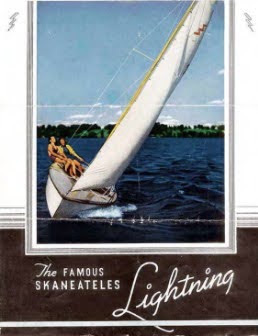
Skaneateles Boat Company was in the forefront in the creation, development, and long-term success of the Lightning Class sailboat and the International Lightning Class Association. Yet it was never the exclusive builder of the boat. The company’s roots date to the late nineteenth century, when the Skaneateles Boat and Canoe Company became widely respected for building high-quality wooden canoes, rowboats, and sailing craft in upstate New York. In 1932, brothers John and George Barnes acquired the business, renamed it Skaneateles Boat Company, and expanded production into competitive one-design racing sailboats.


During the 1930s, the company searched for a new type of boat that could combine family day sailing with high-performance racing. Working closely with naval architects Sparkman & Stephens and designers Olin Stephens and Rod Stephens, Skaneateles Boats helped develop the 19-foot Lightning, first launched in 1938. The company built Hull #1 and used it as a prototype and testing platform before introducing the design at the New York Boat Show, where early demand quickly established the Lightning as a major new one-design class.

Skaneateles Boats constructed almost 1/3 of the first 5000 Lightnings built and was instrumental in organizing the early class association, fleet structure, and championship events. Equally important, the company and Sparkman & Stephens granted the design rights to the class association itself after an agreed upon number of boats had been built. Doing so supported class growth by allowing multiple builders and home builders to produce the boat, instead of being limited by one builder.


The Skaneateles Boat Company and the Lightning are also a technology story. The mold, or jig, used to construct the boat, facilitated rapid, consistent, and accurate construction. While not used on the Lightning, the company and its owners held a patent on what would later be known as vacuum bagging in the boat building industry.


Through craftsmanship, innovation, and an unusually cooperative vision for one-design sailing, Skaneateles Boat Company helped transform the Lightning into one of the world’s most enduring and successful racing sailboat classes, with more than 15,000 boats eventually built worldwide.

Skaneateles_Country_Club.jpg

Skaneateles Country Club

Home of Lightning Fleet 1, the Skaneateles Country Club and its members were closely involved in the development of the Lightning Class sailboat and the International Lightning Class Association. As early as 1932, Club members led by C. Lindzey Nicholson II and Barnes brothers were working to establish the design criteria for a boat similar in design to the Comet, but larger, more seaworthy, and comfortable. With these criteria in hand, Olin Stephens and the Barnes brothers began an iterative design process, resulting in the Lightning.

The Club and its members in 1938 hosted the launch of Lightning #1 and put her through her paces. As key sponsors of the Lightning, the Skaneateles Country Club was instrumental in the establishment of the International Lightning Class Association in order to protect its design and the rules for its construction and racing and promote its growth. Club members C.Lindzey Nicholson and E. Gordon Cronk became the Class Association’s first President and Secretary-Treasurer, respectively.


Additionally, Cronk owned the first boat registered in the Class. Club member and Lightning builder George Banes won the first two Lightning Class National Championships in 1939 and 1940, while the Club hosted the National Championship in 1941 and 1946.


Beginning in 1978 the Skaneateles Country Club hosted the 40th anniversary regatta with 110 Lightnings participating. In 1988 at the 50th anniversary of the class, there were 226 boats present. Since then, the club has hosted the 60th, 70th, 80th, and in 2028 will host the 90th anniversary regatta. These are special events celebrating the Lightning Class origins and future.

Karl_Smither.jpg

Karl Smither

Karl Smither was a leader in the early growth and long-term success of the International Lightning Class Association. A highly respected competitor, mentor, race official, and ambassador for the class, Smither helped shape the culture and standards that made the Lightning one of the world’s most enduring one-design sailboat classes.


Based out of the Buffalo Canoe Club, Smither emerged as a top sailor during the formative years of the Lightning class in the 1940s and 1950s. He won the 1943 Lightning International Championship and finished in second place 4 consecutive years (1944-1947). He consistently finished among the class leaders in many major regattas. He also served as Class President in 1949.


Beyond “Mr. Lightning’s” own racing success, he was admired for his sportsmanship, fairness, and dedication to mentoring younger sailors. Many competitors and race officials later credit Smither with establishing the high standards of Corinthian competition that became hallmarks of the Class.


Smither also contributed to documenting and promoting the class. In 1949 he produced a film covering one of the first true North American Championships, preserving important early Lightning history during a period of explosive growth for the class.


His influence also extended through generations. His family became deeply intertwined with Lightning sailing and boatbuilding through the Allen family and Allen Boat Company, one of the class’s most important boat builders. Today, the prestigious Karl Smither Award honors sailors who exemplify mentorship, enthusiasm, and Corinthian spirit within the Lightning community.


Photo (left to right) Bob Crane, Karl Smither and Reg Pegrum at 1943 National Champion

Tom_G._Allen_III.jpg

Tom G. Allen III

Tom Allen is widely acclaimed as the greatest Lightning sailor of all time. He was 4-time World Champion (1961, 1963, 1965, 1977), 8-time North American Champion (1954, 1955, 1961, 1962, 1965, 1968, 1969, 1970), Boat Builder, Sail Maker, Technical Expert, and Mentor to thousands of competitors and friends.


Allen guided the Lightning Class through the transition from wooden boats to fiberglass construction with his participation as both a technical advisor to the Class as well as one of leading boat builders manufacturing the Lightning. The company he founded, Allen Boat Company in Buffalo NY, became the largest manufacturer among the more than 40 professional builders who have manufactured the Lightning.


Tom Allen’s lifetime contributions to the Lightning Class are central to the story of success of the boat and the Association and inseparable from it.


Well known for his quiet, yet completely approachable demeanor, he was always willing to engage and answer questions from those who sought to emulate Tommy, who was the model for Lightning Sailors.

Inaugural Class of 2026, Public Announcement:
Lightning North American Championship
August 14, 2026 – Sheboygan, WI


Nominations for the 2027 Lightning Class Hall of Fame are now being accepted! You can learn more about the nomination process & submit a nomination here. Nominations can be for an individual or a group of individuals (such as a fleet), a company, a Yacht Club or other entity.

Nominations may be submitted at any time. However, only those received prior to January 4, 2027 will be combined with unselected nominations from each of the two prior years and considered for 2027 selection.

2027 Hall of Fame Nomination Form

Hall of Fame Steering Committee

  • John Rudd (FLBM Board)
  • Meredith Killion (ILCA Ex Comm)
  • Ed Wightman (FLBM Founder)
  • Roger Slade (CNY Commodore)
  • Nicole Katsur (FLBM Programs)
  • Laura Jeffers (ILCA Ex Secy)
  • Bob Astrove (ILCA Classic Boats)

Process Workgroup

  • Bertie Werley
  • Dave Sprague
  • Jim Force
  • Bob Astrove

Hall of Fame Selection Committee

  • John Rudd (Chair)
  • Larry MacDonald
  • Bob Wardwell
  • Jan Davis
  • Paco Sola


Support from Corky Gray, ILCA Historian